Matching (MAT)
Matches are two terms separated by an equals sign (=).
Note
- Answer options are always randomized
- The default grading method is set to "All or nothing"; this can be changed manually (see alternate methods) in the LMS.
- Matches must have choices in a 1:1 ratio (blank choices can be added manually in the LMS).
Info
Use the format:
a. Choice 1 = Match 1
b. Choice 2 = Match 2
c. Choice 3 = Match 3
Basic example
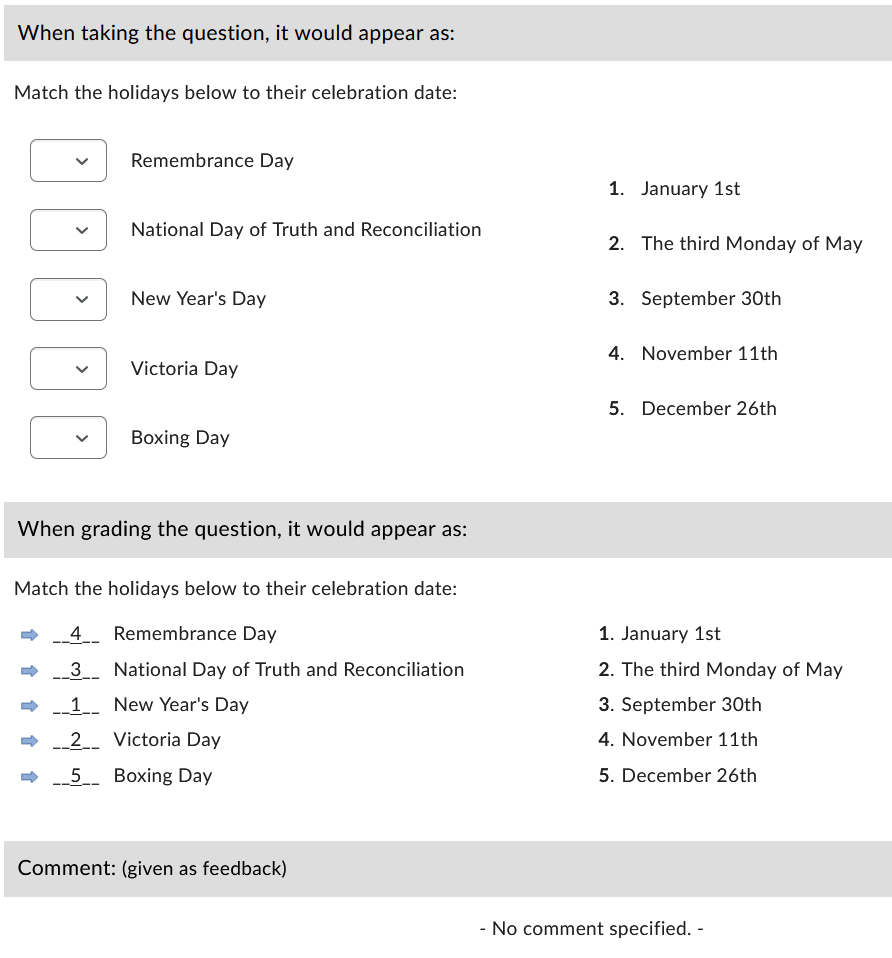
1. Match the holidays below to their celebration date:
    a. January 1st = New Year's Day
    b. The third Monday of May = Victoria Day
    c. September 30th = National Day of Truth and Reconciliation
    d. November 11th = Remembrance Day
    e. December 26th = Boxing Day
With general feedback
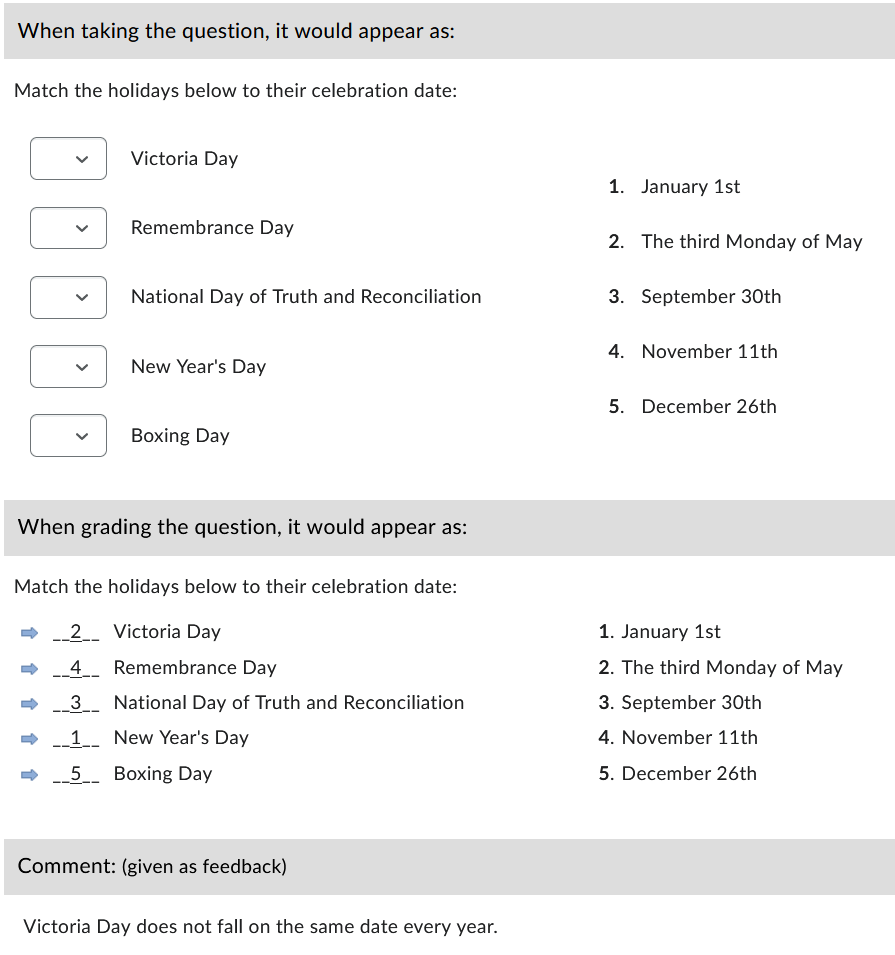
1. Match the holidays below to their celebration date:
    @feedback: Victoria Day does not fall on the same date every year.

    a. January 1st = New Year's Day
    b. The third Monday of May = Victoria Day
    c. September 30th = National Day of Truth and Reconciliation
    d. November 11th = Remembrance Day
    e. December 26th = Boxing Day
With answer key (info)
Note
- Use a semicolon (;) to separate matches.
1. Match the holidays below to their celebration date:
2. ...

Answers:
    1. January 1st = New Year's Day; The third Monday of May = Victoria Day; September 30th = National Day of Truth and Reconciliation; November 11th = Remembrance Day; December 26th = Boxing Day
    2. ...
Special cases
Equals sign (=) is within the choice/match
If part of a choice or match contains an equals sign (=) you can use double equals signs (==) to separate correct matches.
1. Match the correct statements:
    a. 3 + 2 = 5 == Correct
    b. 2 + 2 = 5 == Incorrect
    c. ...