Basic Question Types
The examples below represent straight-forward versions of each question type with the correct answer(s) indicated.
Additional details about each question type are available through the links in the navigation menu.
Note
- The examples below demonstrate how to specify correct answers inline (recommended). See using an answer key for an alternate method.
- The Output below was generated using an example Word document:
True/False (TF)
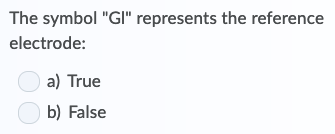
2. The symbol "Gl" represents the reference electrode:
    a. True
    b. *False
Multiple Choice (MC)
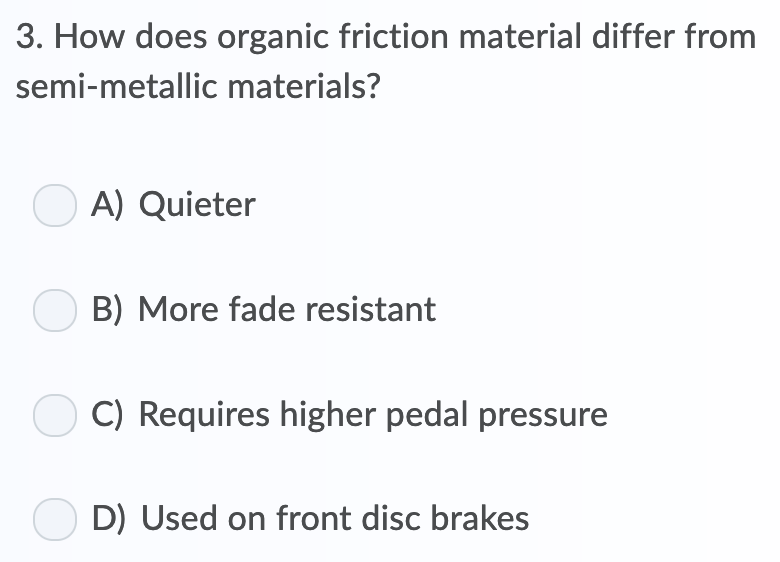
3. How does organic friction material differ from semi-metallic materials?
    a. *Quieter
    b. More fade resistant
    c. Requires higher pedal pressure
    d. Used on front disc brakes
Multi-Select (MS)
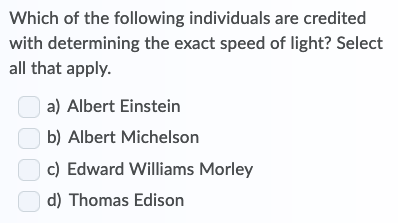
4. Which of the following individuals are credited with determining the exact speed of light? Select all that apply.
    a. *Albert Einstein
    b. *Albert Michelson
    c. Edward Williams Morley
    d. Thomas Edison
Written Response (WR)
Also known as the Essay or Long Answer question type.
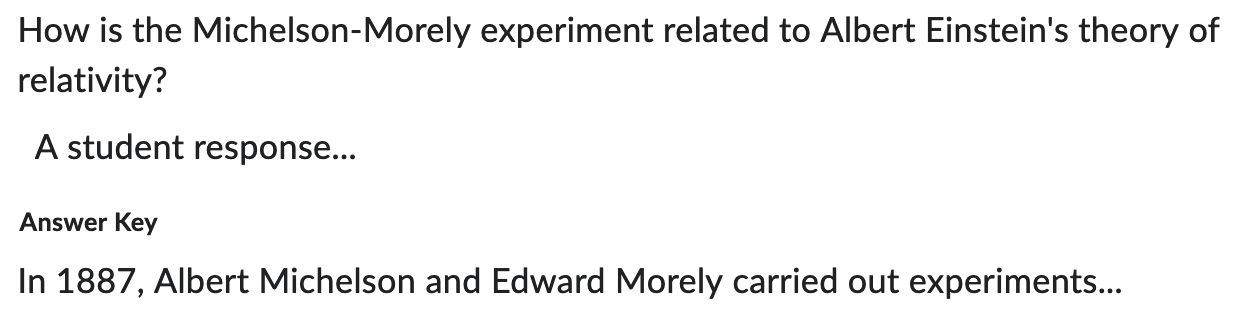
5. How is the Michelson-Morely experiment related to Albert Einstein’s theory of relativity?
    a. In 1887, Albert Michelson and Edward Morely carried out experiments...
Fill-in-Blank (FIB)
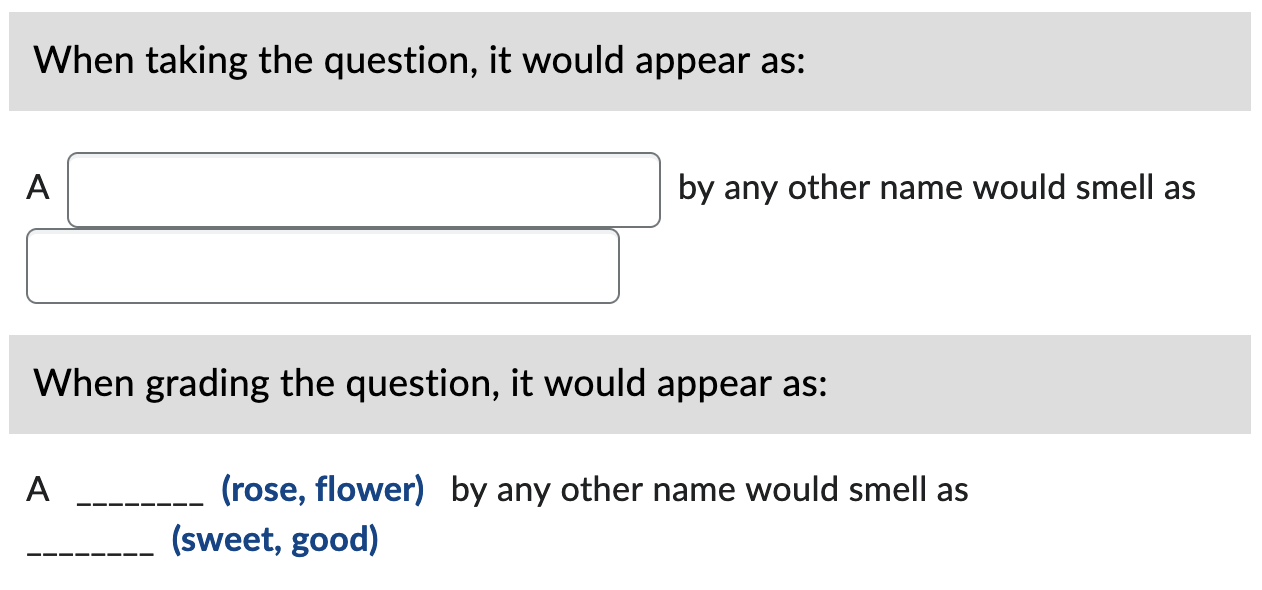
For each word(s) that will be blank, use square brackets and then include all acceptable forms of the answers inside. Spelling counts! Case does not.
6. A [rose, flower] by any other name would smell as [sweet, good].
Matching (MAT)
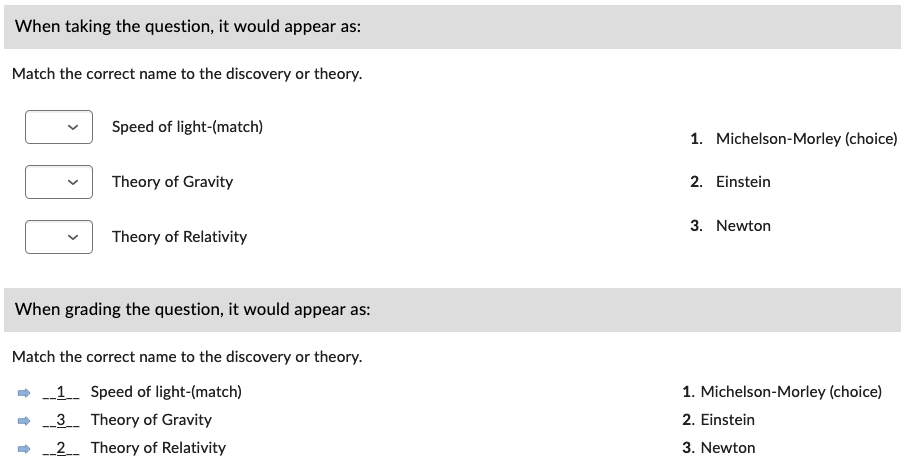
List each matching pair in an ordered alphabetical list. Specify a choice first, followed by an equals (=) sign, followed by a match.1
7. Match the correct name to the discovery or theory.
    a. Michelson-Morley (choice) = Speed of light (match)
    b. Einstein = Theory of Relativity
    c. Newton = Theory of Gravity
Ordering (ORD)
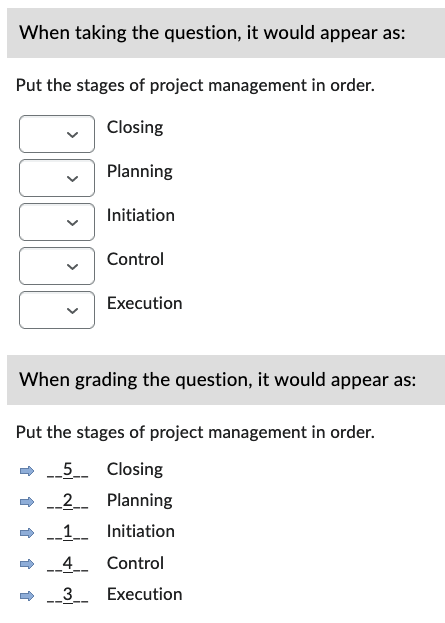
Use an ordered alphabetical list to arrange the answer options in the correct sequence:
8. Put the stages of project management in order.
    a. Initiation
    b. Planning
    c. Execution
    d. Control
    e. Closing
-
Matches must have choices in a 1:1 ratio (no blank choices) ↩